
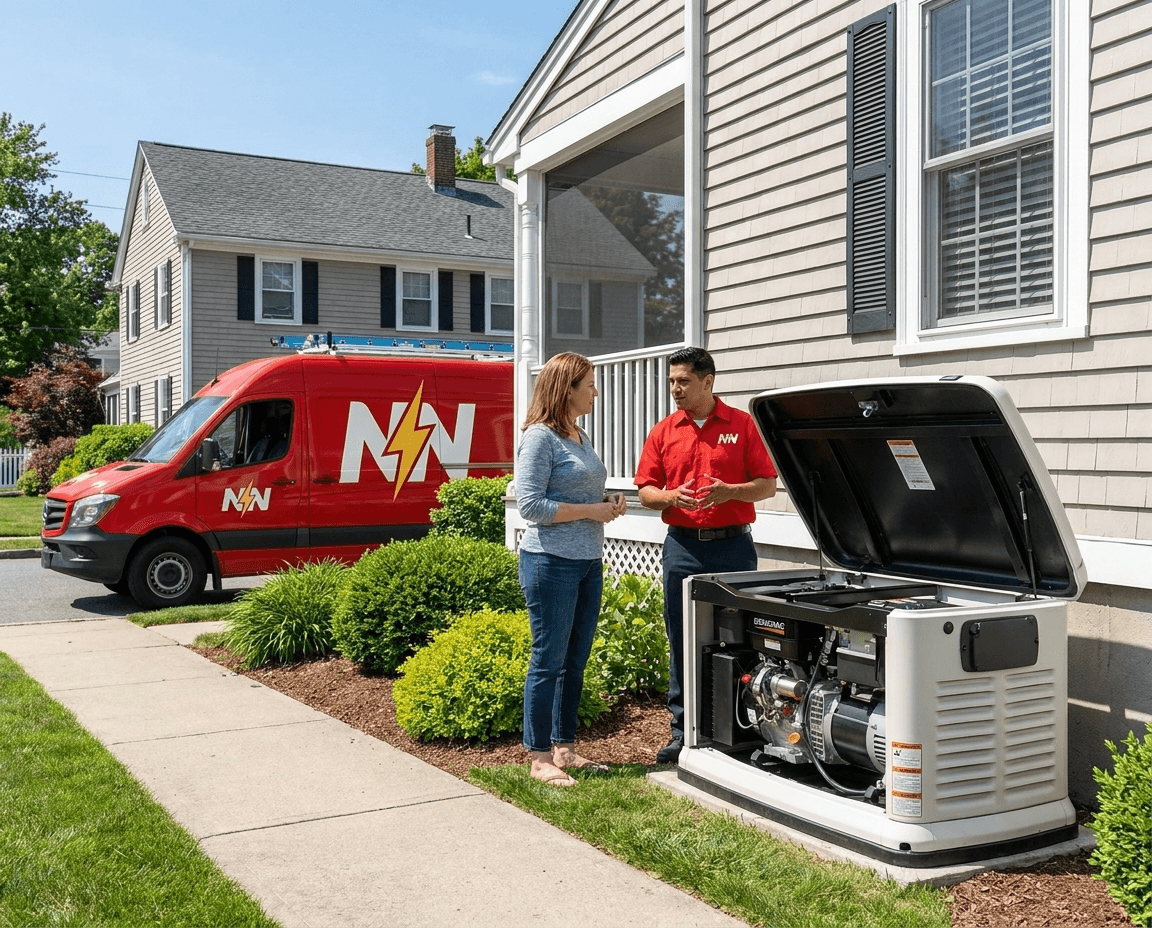
Generator Installation
New England outages are not rare and they are not short. A standby generator starts on its own within seconds and runs until the power returns — no cables, no fuel cans, nobody standing in the cold.
- In business
- 5 years
- Starts
- Automatically, in seconds
- Permits
- Electrical and gas
- Servicing
- Annual, by us
What we handle
Pick the job closest to yours for detail on how it works, what affects the cost, and what happens on the day.
Do you need a standby generator?
Not every household does. The honest test is what actually goes wrong when your power fails, and how long it typically stays off.
Where outages last hours and someone is home, a battery or a properly connected portable may be enough. Where they last days, or where a sump or well pump means the house floods without power, standby is the answer.
- Outages in your area regularly last more than a few hours
- A sump or well pump makes power non-optional
- Nobody is reliably home to start anything
- Medical equipment depends on continuous supply
- Freezers, aquariums, or livestock cannot be left
- A business loses revenue for every hour it is down
Never back-feed through an outlet
Connecting a portable generator into a dryer or range outlet energises your wiring with no isolation from the utility. It can kill a line worker who believes the circuit is dead. A proper inlet and interlock costs very little by comparison.
Sizing is the decision that sets the budget
A true whole-home unit runs everything at once, including central air and an electric range. That is a large machine with a price to match.
Many households are better served by a smaller unit covering essential circuits, with load management to shed large loads when the generator is near capacity. The cost difference is significant; the difference in comfort during an outage is often small.
- 1
List what actually has to run
Heating, refrigeration, pumps, lighting, internet, and any medical equipment. Central air is usually what pushes a unit into a larger size.
- 2
Load calculation, not a rule of thumb
We calculate against your real service and loads rather than sizing by square footage, which routinely produces a generator larger than you need.
- 3
Consider load management
Shedding and restoring large loads automatically often lets a smaller unit cover more of the house than its rating suggests.
- 4
Choose the fuel
Natural gas where a supply exists, since there is no tank to refill. Propane where there is none, with tank size setting how many days of runtime you get.
It is not fit and forget
A standby generator spends nearly all its life doing nothing, which is exactly why it needs servicing. When one fails during an outage the cause is almost never dramatic — most often it is a battery that sat through a New England winter in an unheated enclosure.
The weekly self-test confirms the unit starts. It does not confirm it can carry your house, because it runs with no electrical load. That is what an annual service with a load test is for.
Straight answers
The things people ask most before booking. If yours is not here, ask it and a licensed electrician will answer.
- How big a generator do I need? +
- It depends on what you want running at once, not on your square footage. A whole-home unit running central air and an electric range is large. Many homes do better with a smaller unit on essential circuits plus load management. We size it after listing what actually matters.
- How long does installation take? +
- The physical work is two to three days. The full project usually runs several weeks, driven by equipment lead time and permit processing, both of which vary by town. We give you the current picture at quote stage.
- Natural gas or propane? +
- Natural gas if you have a supply, since there is no tank and no refuelling. Propane where there is no gas line, or where you want a fuel source independent of the network. Tank size then determines runtime.
- What permits are needed? +
- Normally an electrical permit and a gas permit, both inspected. Some towns also have noise ordinances or setback requirements affecting placement. We confirm all of it before installing rather than at inspection.
- How often does it need servicing? +
- Annually for most residential units, or by run hours per the manufacturer. Commercial and critical installations are often semi-annual. Best booked before storm season, so any parts needed arrive while supply is normal.
- Would a battery be better than a generator? +
- For short outages, often yes. Batteries transfer instantly, make no noise, and need no fuel, but they cover hours rather than days. If your outages run long or a pump is critical, that points to a generator.
- Do you service generators you did not install? +
- Yes. Inheriting a unit with a house is common. A baseline service tells you its condition, whether it has been maintained, and what it will need.